
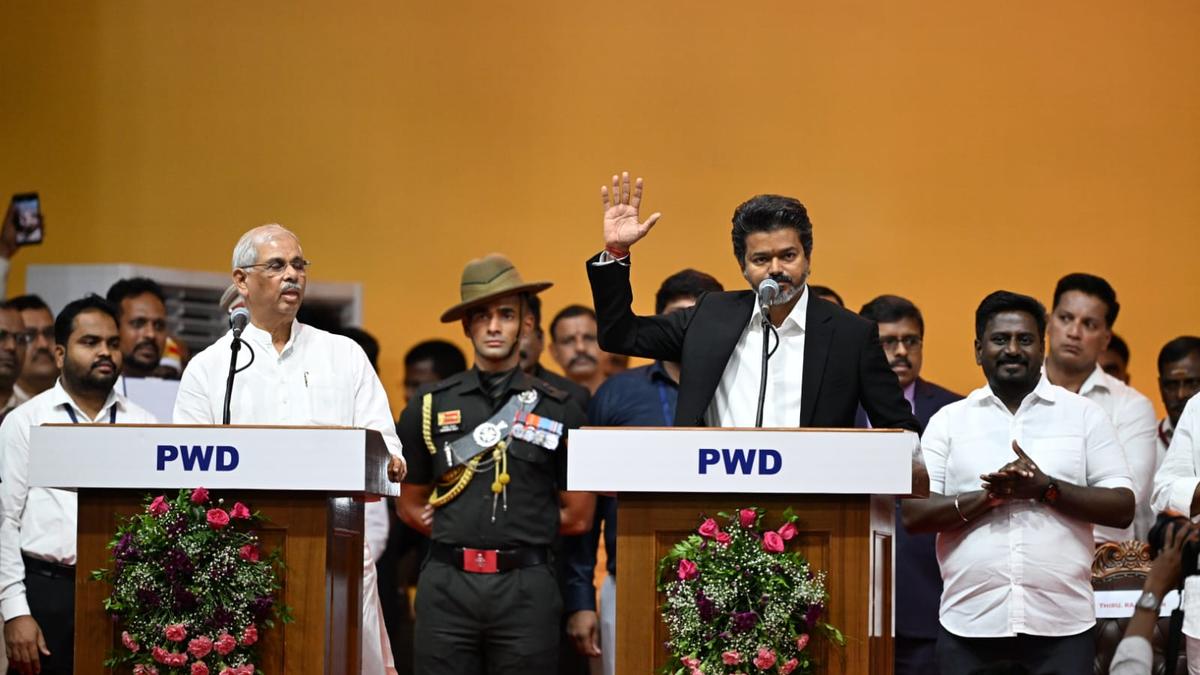

On May 10, 2026, C. Joseph Vijay raised his right hand at Jawaharlal Nehru Stadium in Chennai and took oath as Tamil Nadu’s Chief Minister — ending nearly 60 years of DMK-AIADMK dominance. But who really is this man? Beyond the blockbusters and the box-office records, there are stories, facts, and chapters in Vijay’s life that most people have never heard. Here are 10 of the most fascinating ones.
Fact #1
His Father Had a Dream — And He Wrote It Down

Director S.A. Chandrasekhar — Vijay’s father — harboured not one but two dreams for his son. First: that Vijay would become a superstar like Rajinikanth. Second: that he would use that stardom to become the Chief Minister of Tamil Nadu. On May 10, 2026, both dreams came true in a single lifetime.
SAC introduced Vijay to cinema as a child artist in the 1984 film Vetri, when Vijay was just 10 years old. He also directed Vijay’s debut as a lead hero in Naalaiya Theerpu (1992). Few fathers have been so deliberately, methodically involved in architecting a son’s destiny.
“Chandrasekhar had two primary dreams for his son. The first was for Vijay to become a superstar like Rajinikanth. The second was for him to leverage that stardom to become the Chief Minister.”
— Kerala Kaumudi, May 10, 2026Fact #2
Born at the Intersection of Two Faiths
Joseph Vijay Chandrasekhar was born on June 22, 1974 in Chennai. His father S.A. Chandrasekhar is a Christian, and his mother Shobha Chandrasekhar is a Hindu. Growing up at the intersection of two faiths — in a state defined by caste and religious politics — may have deeply shaped his secular world-view and his insistence that Tamil Nadu’s social harmony must be protected at all costs.

Chennai, Tamil Nadu — the city where Vijay was born and where he will now govern
His mother Shobha is a talented playback singer, music composer and writer who recorded 12 film songs during her career. Music was the atmosphere Vijay grew up in — which explains why he became one of the few Tamil actors known as much for his dancing and screen energy as for his dialogue delivery.
Fact #3
69 Films. One Party. One Mandate.
Vijay acted in 69 films over a 34-year career — from the shy romantic hero of Poove Unakkaga (1996) to the action-packed blockbusters of Ghilli (2004), Mersal (2017), Leo (2023), and finally Jana Nayagan (2025), his farewell to cinema. That last film’s title — Jana Nayagan, meaning “People’s Leader” — reads almost like a prophecy.

34 years of Tamil cinema — now replaced by governance
TVK rallies drew massive crowds across Tamil Nadu
Fact #4
His Wife Was a Fan Who Flew from London to Meet Him
The love story behind Tamil Nadu’s new First Family is the stuff of films. Sangeetha Sornalingam, a Sri Lankan Tamil settled in London, was a devoted Vijay fan. She travelled from London to Chennai specifically to meet him. Those meetings gradually blossomed into love, and their families arranged the marriage on August 25, 1999.
The couple has two children — son Jason Sanjay (born 2000), who is stepping into the film world as an aspiring filmmaker, and daughter Divya Sasha, currently studying abroad. Despite being married to one of India’s biggest stars and now a Chief Minister, Sangeetha has consistently maintained a remarkably low public profile.
⭐ Vijay’s Family at a Glance
- Father: S.A. Chandrasekhar — director of 70+ films
- Mother: Shobha Chandrasekhar — playback singer & composer
- Wife: Sangeetha Sornalingam — Sri Lankan Tamil, private life
- Son: Jason Sanjay — aspiring filmmaker
- Daughter: Divya Sasha — studying abroad
- Maternal Uncle: SN Surendar — playback singer & actor
- Cousin: Vikranth — actor in 20+ films
Fact #5
His Movies Were Already Political Manifestos

Long before Vijay filed his nomination, his films were filing complaints against the system. Kaththi (2014) took on the corporate theft of farmers’ land. Mersal (2017) made a surgical strike against GST and private hospitals’ exploitation of the poor. Sarkar (2018) depicted a non-resident Indian returning to clean up corrupt local politics — a storyline so provocative it drew protests from ruling party politicians.
Each of these films gave Vijay a platform to shape public opinion on governance, welfare, and justice — long before he had a party manifesto to stand on. His fans didn’t just watch these films; they debated them, spread them, and absorbed their politics.
“I’ve left my film career behind to serve the people. I’m here to fight for them.”
— Vijay, TVK Mahanadu inaugural address
Fact #6
He Broke a 59-Year Political Lock
Since 1967, Tamil Nadu has been governed exclusively by either the DMK or the AIADMK — two Dravidian political behemoths that shared power like a relay baton for nearly six decades. Every single Chief Minister of Tamil Nadu since M. Karunanidhi’s first term belonged to one of these two parties.

The 2026 Tamil Nadu election rewrote the state’s political history
Vijay and TVK shattered that duopoly in their very first election — emerging as the single largest party and forming a government with smaller coalition partners who were united by one goal: keeping both the BJP and the AIADMK out of power. It is one of the most dramatic democratic upsets in Indian state-level politics in decades.
1967
DMK-AIADMK duopoly begins
Karunanidhi’s DMK ends Congress rule. For 59 years, no third party governs Tamil Nadu.
Feb 2024
TVK is born
Vijay launches Tamilaga Vettri Kazhagam and announces focus on 2026 elections, skipping 2024 Lok Sabha polls entirely.
Sep–Dec 2025
State-wide political tour
Vijay tours all districts, completing his film career with Jana Nayagan before fully dedicating himself to politics.
2026 Elections
TVK wins 108 of 234 seats
TVK finishes ahead of both DMK and AIADMK. Coalition support secures the majority needed to form government.
May 10, 2026
CM Vijay takes oath
At Jawaharlal Nehru Stadium, Chennai, the 59-year duopoly ends. A new chapter for Tamil Nadu begins.
Fact #7
He Targeted 2 Crore Members Before a Single Vote Was Cast
Most new parties in India struggle to build grassroots infrastructure. TVK set itself a target of enrolling 2 crore (20 million) members across Tamil Nadu before the elections — an extraordinary organisational ambition for a party that was barely two years old. The party conducted booth-level conferences, student outreach programs, and district-by-district membership drives to build the kind of ground network that took older Dravidian parties decades to establish.
The strategy worked. When the votes were counted, TVK had not just won seats — it had built a mass movement.

TVK’s grassroots mobilisation targeted every constituency in Tamil Nadu
Fact #8
Day One: Three Promises Signed Before He Even Spoke
Before addressing the massive crowd at Nehru Stadium on May 10, Vijay signed three executive orders — making them law on his very first day in office. The three pledges:
📋 Day-One Executive Orders
- ⚡ 200 units of free electricity for every household in Tamil Nadu
- 🦁 Singa Penne (“Lioness”) scheme — dedicated women’s safety initiative
- 🌿 Drug-free Tamil Nadu package — comprehensive anti-substance-abuse measures
Political observers noted that the symbolic act of signing before speaking sent a deliberate message: this government will act first and speak second. For a state used to campaign promises evaporating after elections, it was a calculated and significant gesture.
Fact #9
His Role Models? MGR and Jayalalithaa
On January 30, 2026 — just months before the election — Vijay publicly named his political role models: M.G. Ramachandran (MGR) and J. Jayalalithaa. The choice was telling. Both were actors who entered politics and transformed Tamil Nadu’s welfare landscape. Both built mass followings that transcended traditional political boundaries. And both are remembered not just as politicians, but as people’s leaders.

Jawaharlal Nehru Stadium — where Vijay took his oath

Fort St. George, Chennai — seat of Tamil Nadu’s government
By invoking MGR and Jayalalithaa — both from the AIADMK tradition — Vijay signalled that his political vision draws from the welfare-state model of Tamil politics, not from the identity-politics playbook. His admiration for predecessors who prioritised ordinary people over elite interests has consistently shaped his public messaging.
Fact #10
The Governor Drama: A Constitutional Cliffhanger
Vijay’s path to the CM’s chair was not entirely smooth. On May 6, 2026, after TVK emerged as the single largest party, Vijay met the Governor and formally staked his claim to form the government. But Governor Rajendra Vishwanath Arlekar was not satisfied with TVK’s majority claim and declined to immediately invite Vijay on May 7 — sparking a tense constitutional standoff that gripped the nation.
The episode raised serious questions about gubernatorial discretion, constitutional conventions, and the role of the Governor in government formation — a debate that has echoed in multiple Indian states in recent years. Ultimately, the political ground held and Vijay was sworn in on May 10. But the drama served as an early reminder that governance — unlike cinema — does not always follow the script.
“I’m like any of you. I’m an ordinary man. I will never give you false promises. I’ll only say what I can deliver.”
— CM Vijay, inaugural address, Jawaharlal Nehru Stadium, May 10, 2026A New Chapter for Tamil Nadu
From a child artist on his father’s film set to the ninth Chief Minister of Tamil Nadu — C. Joseph Vijay’s story is not just about one man’s ambition. It is about a state’s hunger for change. Whether the script of governance matches the promise of the first day remains to be written. But today, at least, Tamil Nadu is turning a page unlike any it has turned in 59 years.